


The first in our ServiceNow Spotlight series, where we unpack the platforms, products, and patterns behind the enterprises that have stopped firefighting and started compounding.
Most IT organizations are still living in a 60/40 world. Roughly 60% of incidents come from machines, including servers, storage, network gear, and 40% are filed by people. Same outages, same frustrated users, yet the two streams rarely talk, because they live in separate systems run by separate teams. Dashboards glow green while real users sit and wait. That disconnect is where trust erodes, and it’s expensive. CEOs now rank gaps in digital and AI execution among their top business risks, according to IDC, and more than half believe AI can reinvent their business model within three to five years.
This is the gap ServiceNow was built to close. In 2026, with an AI-native platform, a unified data foundation, and an autonomous workforce of AI agents, the conversation has shifted from “resolve tickets faster” to “prevent the ticket entirely.” As a ServiceNow implementation partner, that’s where we do our best work. Here’s what the platform is, what’s new, and how we turn it into outcomes for commercial SaaS and public-sector teams alike.

One platform, four workflow areas
ServiceNow - now the ServiceNow AI Platform, built on the Now Platform runs on one data model and one workflow engine, so you build cross-functional workflows instead of stitching point tools together. The applications span four areas:
- Technology Workflows: ITSM, ITOM (AIOps and Visibility), ITAM, and Strategic Portfolio Management (SPM).
- CRM & Industry Workflows: Customer Service Management (CSM), Field Service Management (FSM), and Sales & Order Management, plus industry solutions for public sector, financial services, telecom, and healthcare.
- Core Business Workflows: HR Service Delivery (HRSD), Workplace and Legal Service Delivery, and finance, procurement, and supply-chain workflows.
- Creator Workflows: App Engine for low-code apps and Automation Engine (with Integration Hub) for connecting your stack.
Cutting across all four is Security & Risk which includes Security Operations (SecOps) and Integrated Risk Management (IRM). Everything sits on a shared CMDB, organized by the Common Service Data Model (CSDM), so every team and every AI agent works from the same trusted, real-time view. That shared context is the difference between AI that suggests and AI that resolves.
The new layer: an autonomous workforce
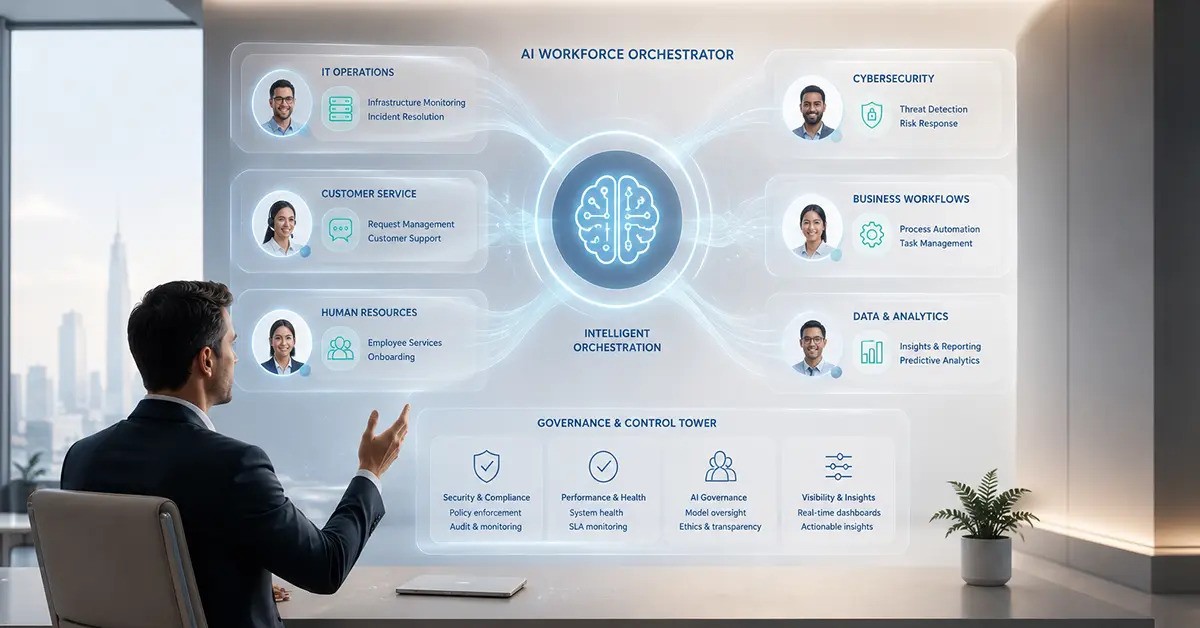
“AI in ServiceNow” used to mean Now Assist -summaries and categorization that handed work back to you. The 2026 story is different. At Knowledge 2026, ServiceNow unified Now Assist, the acquired Moveworks conversational layer, and its AI Experience framework into one AI front door: ServiceNow Otto. A user states intent in plain language, such as chat, search, or voice and Otto routes the request, triggers the workflow, secures approvals, and finishes the job across systems, closing the “completion gap.”
Underneath sit the agentic building blocks: AI Agents (out-of-the-box across ITSM, CSM, HRSD, and SecOps, plus custom-built), AI Agent Studio to build agents in natural language, AI Agent Orchestrator to coordinate them across departments, AI Agent Fabric to unify third-party agents, and AI Control Tower to govern, monitor, and optimize all of it from one place. The leaders aren’t the ones with the most agents, they’re the ones who can govern them.
It all comes back to data
AI is only as powerful as its data. Gartner estimates roughly 60% of AI projects will fail for lack of AI-ready data, and about 63% of organizations lack or aren’t sure they have the right data practices for AI. An estimated 93% of CDOs say success depends on a defined data strategy, per AWS. ServiceNow’s answer: Workflow Data Fabric connects and acts on data wherever it lives, with zero-copy connectors to Snowflake, Databricks, BigQuery, SQL Server, and Oracle; RaptorDB Pro, the native high-performance database, handles operational and analytical workloads together (with Live Connect and Live Archive); and the Data Catalog plus data governance make information classified, contextual, and trusted. Get this layer right and the agents get smarter; get it wrong and even the best AI stalls.
From products to outcomes
ServiceNow packages this into two patterns that map to real pain. Autonomous Service Operations unifies ITSM and ITOM so service and operations teams share data in real time -catching issues before users feel them. Autonomous IT & Security extends that to a proactive posture. Agents that learn what “normal” looks like and remediate vulnerabilities before they become breaches. The goal isn’t replacing people; it’s freeing them from firefighting to innovate.
What we do as your partner
A capable platform only delivers value when it’s architected and adopted well. We help across the full lifecycle:
- Advisory and roadmap: AI strategy, ROI modeling, licensing rationalization, and target architecture.
- Implementation: ITSM, ITOM, ITAM, SPM, CSM, FSM, HRSD, SecOps, and IRM - close to out-of-the-box and aligned to ITIL.
- Data foundation: CMDB/CSDM design, Discovery and Service Mapping, Workflow Data Fabric integrations, and RaptorDB Pro enablement.
- AI enablement: Otto rollout, AI Agents in AI Agent Studio, multi-agent orchestration, and AI Control Tower governance with human-in-the-loop guardrails.
- Custom apps and integrations: App Engine and Automation Engine/Integration Hub, plus connections to AWS, Azure, Google Cloud, ERP, and identity.
- Migration, managed services, and adoption: legacy consolidation, upgrades, ongoing optimization, training, and change management.
- Public-sector delivery: GCC and NSC implementations aligned to FedRAMP, DoD IL, GovRAMP, and accessibility.
The bottom line
The market has moved past AI hype into AI operations. The leaders put AI on one platform, fed it governed data, and freed their people to innovate. ServiceNow supplies the platform, agents, data foundation, and trust framework; the right partner gets you there faster, with outcomes you can defend to a board or an inspector general.
Ready to map your path to autonomous operations? Explore and Contact Us and we’ll show you where the fastest wins are hiding and how to capture them in weeks, not quarters.
Frequently Asked Questions (FAQs)
1. What is the ServiceNow AI Platform?
The ServiceNow AI Platform is an enterprise workflow platform that combines AI, automation, data, and workflow management to help organizations streamline operations across IT, customer service, HR, security, and business functions. It enables organizations to move beyond task automation and toward autonomous operations.
2. How is the ServiceNow AI Platform different from traditional IT service management tools?
Traditional ITSM tools primarily focus on ticket management and service requests. The ServiceNow AI Platform extends beyond ITSM by integrating workflows, enterprise data, AI agents, automation, and orchestration capabilities across multiple departments and systems.
3. What are AI Agents in ServiceNow?
AI Agents are autonomous digital workers that can understand requests, perform actions, execute workflows, and complete tasks with minimal human intervention. They can be deployed across IT Service Management (ITSM), Customer Service Management (CSM), HR Service Delivery (HRSD), Security Operations (SecOps), and custom business workflows.
4. What is ServiceNow Otto?
ServiceNow Otto is the unified AI experience layer within the ServiceNow AI Platform. It enables users to interact with the platform using natural language through chat, search, or voice, while automatically routing requests, triggering workflows, managing approvals, and completing tasks across connected systems.
5. What is AI Agent Orchestrator in ServiceNow?
AI Agent Orchestrator coordinates multiple AI agents across departments and workflows, ensuring they work together to complete complex business processes. It helps organizations automate end-to-end workflows rather than isolated tasks.
6. Why is data important for AI success in ServiceNow?
AI effectiveness depends on access to accurate, governed, and contextual data. ServiceNow supports this through Workflow Data Fabric, Data Catalog, governance capabilities, and integrations with enterprise data platforms, enabling AI agents to make informed decisions and execute workflows more effectively.
7. What business functions can be automated using ServiceNow?
Organizations can automate a wide range of functions, including IT service management, IT operations, customer service, HR processes, security operations, asset management, project portfolio management, procurement workflows, and industry-specific business processes.
8. How does ServiceNow support autonomous operations?
ServiceNow supports autonomous operations through AI agents, workflow orchestration, real-time data visibility, automated remediation, predictive insights, and integrated service and operations management. This allows organizations to proactively resolve issues before they impact users.
9. What services does a ServiceNow implementation partner provide?
A ServiceNow implementation partner can help with strategy, platform implementation, workflow design, CMDB and CSDM setup, AI enablement, integrations, migration, managed services, governance, training, and adoption programs to maximize business value from the platform.
10. How can organizations get started with ServiceNow AI and workflow automation?
The best starting point is to assess existing workflows, identify automation opportunities, establish a strong data foundation, and develop a roadmap aligned with business objectives. Working with an experienced ServiceNow partner can help accelerate implementation and adoption while reducing risk.
11. Is ServiceNow suitable for public sector organizations?
Yes. ServiceNow provides solutions and deployment options that support public sector requirements, including governance, compliance, accessibility, security, and regulatory frameworks, making it suitable for government agencies and public sector organizations.
12. What are the benefits of adopting the ServiceNow AI Platform?
Organizations can benefit from faster service delivery, reduced operational costs, improved employee and customer experiences, enhanced visibility across workflows, stronger governance, proactive issue resolution, and accelerated digital transformation initiatives.
Stats referenced are drawn from IDC, Gartner, AWS, and publicly available ServiceNow customer case studies; individual results vary by environment and scope.
Up next in the series: unifying ITSM and ITOM, and the data decisions that make or break agentic AI.

Want to start a project?
Get your Free ConsultationOur Recent Blog Posts



















































































































© 2026 CSM Tech Americas All Rights Reserved